THE KEELING CURVE
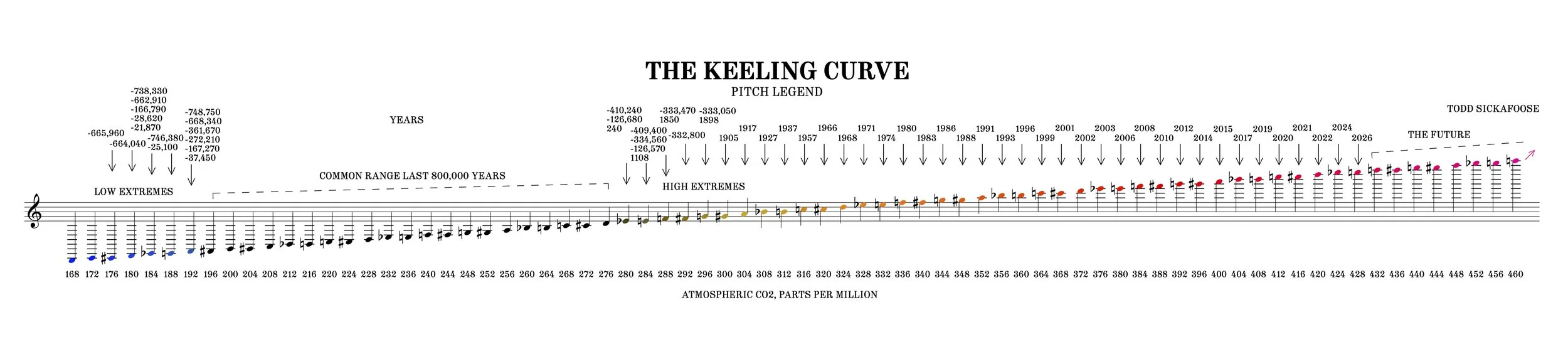
The Keeling Curve – the title of this piece and the name of its primary datasource – uses the last 800,000 years of atmospheric CO2 data to form a 24-hour melody. In addition to tonally hearing the CO2 parts-per-million (ppm) in the atmosphere rise and fall, the number is also spoken every 1000 years (about every minute and 48 seconds) by our narrator, Rupa Marya.
Music by Todd Sickafoose (Group Chirp Music / BMI).
Recorded and produced by Todd Sickafoose @ Earycanal.
< FAQ >
How fast is time moving in this piece?
– Each second represents about a decade.
How did you turn the Keeling Curve into a melody?
– The drone rises and falls in pitch as the Keeling Curve's CO2 measurement rises and falls. 265 ppm equates to middle C and pitch rises a half-step for each additional 3 ppm. (It can be interesting to listen for extended periods of low pitches – those correspond to ice ages. There are seven ice ages represented here, the last of which is called the Wisconsinan Ice Sheet and bottoms out 15 minutes into the final hour. It is the eeirily steady warming period that follows which lays the fertile bed for population explosions of homo sapiens over the last 15,000 years.)
Why do the last 11 seconds of the piece sound so alarming?
– As you probably guessed, that sudden, rapid rise in pitch represents the uniquely human effect on C02 in the atmosphere. The current C02 reading (on January 1st, 2026) is 428 ppm. At no other point in the last 800,000 years has the number been anywhere above 300 ppm.
Why do the first few minutes sound murky – and then everything comes into focus?
– That's a musical representation of the Earth's most recent magnetic pole flip (aka the Brunhes–Matuyama reversal). It occured about 800k years ago – so right at the beginning of this piece.
How long have you been working on this?
– A little bit at a time over the last four years.
Thanks to my friend Amy Martin (host of the Peabody Award-winning environmental podcast Threshold) who dared me to make this piece after we hatched it in conversation. The first incarnation was a mere 20 minutes! But 24 hours makes a more appropriately vast canvas to show scale – and it's a length of time that is very familiar and understandable. Big thanks to Leif Karlstrom (fiddler extraordinaire and earth scientist at the University of Oregon) who helped me hone a list of geologic events to represent (audible in subsequent versions) but who has also generally guided my journey into data sonification. Check out his Volcano Listening Project. Thanks to Bandcamp for making accomodation to distribute this oversized recording. And thanks to you, listeners and readers, for supporting this unusual project.